





Introduction
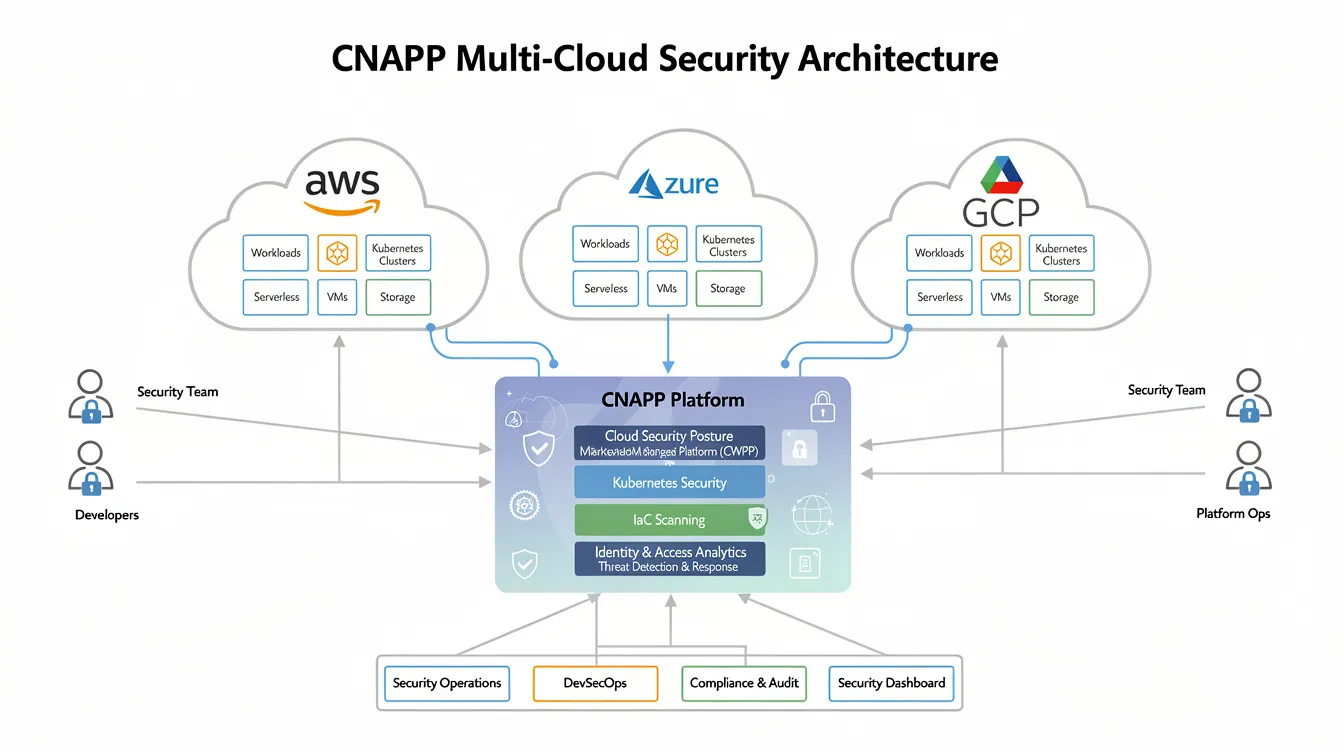
CNAPP security represents a unified approach to protecting cloud-native applications across their entire lifecycle, from development through production runtime. A Cloud-Native Application Protection Platform (CNAPP) integrates cloud security posture management, cloud workload protection platform capabilities, and cloud infrastructure entitlement management into a single platform that addresses the security challenges of dynamic cloud environments.
This guide targets IT professionals, cloud security teams, DevSecOps engineers, and enterprise security decision-makers who manage cloud-native infrastructure across AWS, Azure, Google Cloud, or hybrid cloud environments. These leading cloud platform providers play a crucial role in enabling unified security management by offering seamless API integrations and compatibility with a wide range of cloud service ecosystems. The content covers technical architecture, component capabilities, implementation strategies, and vendor evaluation criteria for organizations evaluating or implementing CNAPP solutions.
Direct answer: CNAPP security provides integrated cloud security posture management, workload protection, and identity management in a single platform, enabling comprehensive visibility, automated threat detection, and unified risk management across cloud-native applications and infrastructure by integrating a comprehensive suite of cloud security tools that work together for automation, threat detection, and unified management.
Key outcomes from this guide:
-
Understanding CNAPP architecture and how security components integrate for unified protection
-
Evaluating cloud security capabilities including CSPM, CWPP, CIEM, and runtime protection
-
Implementing DevSecOps workflows with shift-left security integration
-
Comparing CNAPP against traditional security tools and point solutions
-
Establishing enterprise cloud security strategies for multi-cloud environments
Understanding CNAPP Security Fundamentals
Cloud-native environments present unique security challenges due to rapid development cycles, ephemeral workloads, and complex multicloud architectures. These factors expand the attack surface and complicate comprehensive security efforts. CNAPPs emerged as a response to the challenges posed by traditional security tools that operate in silos, providing a consolidated approach to security that enhances visibility, risk management, and compliance across cloud-native applications, while also managing cloud infrastructure through integrated security solutions.
Visibility gaps in cloud environments can lead to undetected security issues such as misconfigurations, vulnerabilities, and compliance gaps. CNAPPs address these challenges by providing unified monitoring and automated remediation, helping organizations proactively identify and resolve risks.
What is CNAPP Security
A Cloud-Native Application Protection Platform (CNAPP) is a unified security solution designed to address the entire lifecycle of cloud-native applications, integrating a range of security and compliance capabilities within a single platform. Gartner introduced the CNAPP category in 2021 to describe platforms that consolidate multiple cloud security functions—including posture management, workload protection, identity governance, and data security—into a cohesive framework.
CNAPPs integrate proactive security scanning with reactive threat detection and response. The architecture unifies multiple security functions into a single, integrated platform, facilitating seamless collaboration across security, operations, and development teams to ensure risks are identified and mitigated throughout the application lifecycle.
The platform supports cloud-native architectures including:
-
Containers and Kubernetes: Runtime protection and kubernetes security posture management for orchestrated workloads
-
Serverless functions: Security monitoring for ephemeral compute resources
-
Microservices: API security and service mesh integration
-
Virtual machines: Traditional workload protection with cloud-native visibility
Cloud-Native Security Challenges
The shift to cloud-native applications has led to a demand for security solutions that can scale alongside dynamic environments, as traditional security tools designed for monolithic applications are inadequate for modern development practices.
Dynamic infrastructure scalability creates expanded attack surfaces and visibility gaps. Organizations face significant challenges in maintaining visibility across distributed workloads, APIs, and cloud services, which can lead to blind spots and increased vulnerability to attacks. Cloud resources spin up and down continuously, making point-in-time security assessments insufficient for protecting cloud native infrastructure. To address these challenges, continuous security monitoring is essential for real-time threat detection and compliance enforcement. Cloud detection serves as a core component for identifying misconfigurations, vulnerabilities, and suspicious activities across cloud resources, enabling proactive security management.
DevOps velocity requires integrating security into CI/CD pipelines without creating development friction. Security teams must balance thorough vulnerability scanning with release schedules measured in hours rather than weeks. CNAPPs support a shift-left approach by embedding security into DevOps workflows, allowing for early detection of vulnerabilities and compliance issues before deployment.
Multi-cloud complexity demands unified security policies and consistent posture management across multiple cloud providers. Each platform—AWS, Azure, Google Cloud—has different security configurations, identity models, and compliance controls. Without a unified cloud security solution, organizations struggle to enforce security policies consistently across multiple cloud platforms.
The integration of CNAPPs with existing cloud environments helps organizations gain visibility into risks, manage configurations, and ensure secure development while detecting runtime threats. This unified approach bridges the gap between development and security teams.
CNAPP Security Components and Capabilities
The architecture of CNAPPs unifies multiple security functions into a single, integrated platform. CNAPPs use a unified risk engine to map out how vulnerabilities, over-privileged identities, and public network exposures combine. This comprehensive visibility enables organizations to prioritize the most critical risks based on actual exploitability rather than theoretical severity scores.
Cloud Security Posture Management (CSPM)
Cloud Security Posture Management (CSPM) continuously monitors cloud environments for misconfigurations, compliance violations, and security risks, ensuring adherence to security and compliance standards. CSPM capabilities form the foundation of cloud-native security by providing visibility into infrastructure configuration state.
Configuration monitoring and compliance validation spans AWS, Azure, Google Cloud, and hybrid cloud environments. CSPM tools assess cloud resources against security benchmarks including CIS Controls, NIST frameworks, and cloud provider-specific best practices. Continuous monitoring identifies configuration drift that could expose sensitive data or create security gaps.
Automated policy enforcement enables organizations to enforce security policies at scale. When CSPM detects misconfigurations—such as publicly accessible storage buckets or unencrypted databases—automated remediation capabilities can correct issues without manual intervention. This security automation reduces operational overhead and ensures consistent security controls.
Infrastructure as Code (IaC) scanning analyzes configuration files and deployment templates early in the development pipeline to catch flaws before code is deployed. By scanning Terraform, CloudFormation, and Kubernetes manifests, CSPM capabilities extend shift-left security into the development process. CNAPPs scan source code and container registries during development to catch and remediate vulnerabilities early in the CI/CD pipeline.
Cloud Workload Protection Platform (CWPP)
Cloud Workload Protection Platform (CWPP) provides runtime security for workloads deployed across virtual machines, containers, and serverless functions, protecting them during their most vulnerable stage. CWPP capabilities address threats that emerge after deployment, when applications process production data and interact with external systems.
Runtime protection for cloud workloads includes behavior monitoring, anomaly detection, and threat prevention. If a zero-day exploit bypassed pre-deployment scans, CWPP continuously monitors the live environment and flags anomalies in real time. This real-time threat detection enables security teams to respond to potential security incidents before attackers achieve their objectives.
Vulnerability management provides continuous scanning of running workloads to identify known vulnerabilities. CWPP correlates vulnerability data with runtime context—network exposure, identity permissions, and data access—to prioritize the most critical risks. Vulnerability scanning extends to container images, host operating systems, and application dependencies.
Deployment flexibility includes both agent-based and agentless options:
-
Agent-based protection: Deep visibility into host processes, file system activity, and network connections through lightweight agents deployed on workloads
-
Agentless scanning: API-based analysis of cloud resources and configurations without performance impact; agentless scanning allows CNAPPs to map cloud resources and detect risks without hindering performance
Organizations often implement hybrid approaches, using agentless scanning for comprehensive visibility and selective agent deployment on critical assets requiring runtime protection.
Cloud Infrastructure Entitlement Management (CIEM)
Cloud Infrastructure Entitlement Management (CIEM) focuses on managing access and permissions across cloud services, which is critical for reducing insider threats and unauthorized access. Identity sprawl and over-privileged accounts represent significant security risks in cloud native environments where automated processes and service accounts proliferate.
Least-privilege enforcement identifies excessive permissions and recommends right-sizing access rights. CIEM analyzes actual permission usage against granted permissions to detect accounts with capabilities they never exercise. Studies indicate over 90% of IAM roles in enterprise environments have unused permissions that could be exploited by attackers.
Privilege escalation detection monitors for identity-based attack patterns. CIEM capabilities track permission changes, cross-account access, and identity relationships that could enable lateral movement. By integrating identity context with workload and configuration data, CNAPPs provide comprehensive visibility into identity-related risks.
Zero Trust architecture integration extends CIEM capabilities to enforce continuous verification. Access management policies can incorporate workload identity, network context, and data sensitivity to make dynamic authorization decisions. This integration with identity governance frameworks strengthens overall security posture.
Additional Security Components
CNAPPs integrate additional security functions that extend protection across the application lifecycle:
Data Security Posture Management (DSPM) secures sensitive data in cloud environments by continuously monitoring and managing risks across structured and unstructured datastores. DSPM capabilities discover data assets, classify sensitivity levels, and monitor access patterns to protect critical information.
Kubernetes Security Posture Management (KSPM) provides specialized security for Kubernetes, ensuring that these environments remain secure and minimizing the risk of attacks targeting orchestration layers. KSPM validates cluster configurations, network policies, and workload specifications against security benchmarks.
Application Security Posture Management (ASPM) extends scanning to application code, dependencies, and software supply chain components. By integrating with version control and artifact repositories, ASPM enables security teams to track vulnerabilities across the software development lifecycle.
CNAPP Implementation and Architecture
Implementing a CNAPP architecture provides deep operational and defensive advantages, including reduced license costs and operational overhead. By integrating security tools and automated policies, CNAPPs help protect cloud native infrastructure through comprehensive security strategies that safeguard workloads, applications, and configurations across multi-cloud and hybrid platforms. Successful implementation requires aligning deployment methods with organizational security requirements and existing cloud infrastructure services.
For example, CrowdStrike Falcon Cloud Security is a cloud-native security platform that delivers continuous monitoring, threat detection, and incident response across cloud environments.
CNAPP Deployment Methods
Agentless API-based scanning enables rapid deployment and comprehensive cloud coverage. Agentless approaches connect to cloud provider APIs to enumerate resources, analyze configurations, and assess security posture without installing software on workloads. This method provides immediate visibility into cloud environments with minimal operational complexity.
Agent-based runtime protection delivers deep workload visibility and threat detection capabilities. Lightweight agents installed on hosts, containers, or Kubernetes nodes monitor system calls, process behavior, and network activity. Agent-based protection enables detection and response capabilities that agentless scanning cannot achieve, including blocking malicious activity in real time.
Hybrid approaches combine agentless posture management with selective agent deployment on high-value workloads. Organizations typically deploy agents on production systems containing sensitive data or critical assets while using agentless scanning for development environments and less sensitive workloads. This balanced approach optimizes security coverage while managing operational overhead.
CI/CD pipeline integration extends CNAPP capabilities into DevSecOps workflows. By integrating security throughout the entire lifecycle from development to runtime, CNAPPs support DevOps methodologies and cloud-native strategies, ensuring security is part of the CI/CD pipeline without disrupting development speed. Security gates can block deployments that violate policy or contain critical vulnerabilities.
CNAPP vs Traditional Security Platforms
Understanding how CNAPPs compare to individual security tools helps organizations evaluate their cloud security solutions and make informed architecture decisions.
|
Criterion |
CNAPP (Unified) |
CSPM Only |
CWPP Only |
Point Solutions |
|---|---|---|---|---|
|
Coverage Scope |
Full lifecycle: development, deployment, runtime |
Configuration and compliance only |
Runtime workload protection only |
Single security function |
|
Risk Context |
Unified risk graph correlating identity, configuration, and workload |
Limited to infrastructure misconfigurations |
Limited to workload vulnerabilities |
Isolated findings without context |
|
Integration |
Native integration across security functions |
Requires integration with other tools |
Requires integration with other tools |
Multiple integrations required |
|
Alert Management |
Intelligent alert correlation and risk-based prioritization |
Configuration-focused alerts |
Workload-focused alerts |
Siloed alerts across tools |
|
Operational Efficiency |
Single platform reduces tool sprawl |
Multiple tools for complete coverage |
Multiple tools for complete coverage |
High management overhead |
|
Total Cost of Ownership |
Consolidated licensing, reduced integration costs |
Lower initial cost, higher integration costs |
Lower initial cost, higher integration costs |
Cumulative licensing across multiple vendors |
|
DevSecOps Integration |
Native CI/CD integration across security functions |
Limited to IaC scanning |
Limited to container scanning |
Varies by tool |
Decision criteria for enterprise security architecture:
-
Cloud maturity: Organizations early in cloud adoption may start with CSPM before expanding to full CNAPP capabilities
-
Workload types: Container-heavy and Kubernetes environments benefit significantly from integrated CWPP and KSPM
-
Multi-cloud requirements: Organizations using multiple cloud providers gain substantial value from unified policy enforcement
-
DevSecOps maturity: Teams with established CI/CD practices benefit from integrated shift-left security
-
Existing tooling: Evaluate integration requirements with existing security tools including SIEM and SOAR platforms
CNAPPs streamline security operations by integrating various security functions into a cohesive framework, which reduces operational silos and enhances collaboration among security, development, and operations teams.
Common CNAPP Security Challenges and Solutions
Practical enterprise challenges in CNAPP adoption require strategic approaches to maximize security value while managing organizational constraints.
Alert Fatigue and Tool Fragmentation
Challenge: Security teams face overwhelming alert volumes from multiple security tools, making it difficult to identify and respond to critical risks. Traditional security tools generate alerts without contextual correlation, forcing analysts to manually investigate relationships between findings.
Solution: CNAPPs utilize intelligent alert correlation and risk-based prioritization to filter out false positives and surface the most critical issues, helping security teams avoid alert fatigue and respond to mission-critical incidents quickly. The unified risk engine correlates findings across CSPM, CWPP, and CIEM to identify attack paths that represent actual exploitable conditions.
CNAPPs provide full visibility and context across cloud environments, allowing security teams to monitor every component and detect risks in real time, which eliminates blind spots and enhances security decision-making. Unified security operations center (SOC) workflows consolidate incident response across cloud security functions.
Skills Gaps and Manual Processes
Challenge: Cloud-native security requires expertise spanning infrastructure, identity, application security, and cloud provider-specific controls. Many organizations lack sufficient skilled personnel to manage security across dynamic cloud environments.
Solution: CNAPPs automate many security processes, such as configuration checks, threat detection, vulnerability scanning, and policy enforcement, reducing manual intervention and allowing security teams to focus on more strategic priorities. By automating routine tasks like vulnerability scanning and compliance checks, CNAPPs free up resources, allowing teams to focus on higher-value activities, which leads to reduced overhead and faster responses to security incidents.
Organizations can achieve a more robust security posture by using a CNAPP, which improves collaboration among security, development, and DevOps teams. Shared visibility and automated workflows reduce the expertise required for effective cloud security operations.
Multi-Cloud Visibility and Governance
Challenge: Organizations using multiple cloud platforms face inconsistent security controls, fragmented visibility, and difficulty enforcing unified policies. Each cloud provider has different APIs, identity models, and security configurations.
Solution: CNAPPs enhance compliance management by automating compliance checks and continuously monitoring cloud configurations against relevant standards, which helps organizations avoid costly penalties and reputational damage. Centralized security dashboards provide unified visibility across cloud providers, normalizing findings into consistent risk categories.
CNAPPs automate compliance checks by continuously monitoring cloud configurations and assessing them against relevant standards, which helps organizations maintain adherence to regulations like GDPR, HIPAA, and PCI DSS. Cross-platform compliance reporting and consistent security posture enforcement ensure governance requirements are met regardless of underlying cloud infrastructure.
Conclusion and Next Steps
CNAPP security provides organizations with substantial benefits, including improved end-to-end visibility, security automation, adaptive security, reduced complexity, and a solid and compliant cloud security posture. By integrating cloud security posture management, workload protection, and identity governance into a unified platform, CNAPPs enable organizations to protect cloud native applications throughout their lifecycle.
CNAPPs simplify the compliance process by offering prebuilt reporting templates that reduce the burden on security teams during audits, ensuring that compliance issues are addressed promptly. Automated compliance management capabilities provide real-time alerts for policy violations and generate audit-ready reports.
Immediate action items:
-
Security assessment: Evaluate current cloud security posture, existing tools, and security gaps across cloud environments
-
Vendor evaluation: Compare CNAPP solutions against organizational requirements for workload types, cloud providers, and DevSecOps maturity
-
Pilot deployment: Implement CNAPP on representative cloud accounts and workloads to validate capabilities and operational impact
-
Team training: Develop cloud security expertise across development and security teams for effective CNAPP utilization
-
Integration planning: Define requirements for SIEM, SOAR, and CI/CD pipeline integration
Related topics for further exploration:
-
Cloud Security Mesh architecture for distributed security controls
-
DevSecOps maturity models for organizational security culture
-
Zero Trust architecture implementation for identity-centric security
Frequently Asked Questions
What is the difference between CNAPP and SASE for cloud security?
CNAPP and SASE (Secure Access Service Edge) serve different security domains. CNAPP focuses on protecting cloud-native applications, workloads, and infrastructure through posture management, runtime protection, and identity governance. SASE combines network security, WAN optimization, and secure access capabilities for protecting network connections and user access. Organizations often deploy both—CNAPP for cloud workload security and SASE for network and access security.
How does CNAPP integrate with existing SIEM and SOAR platforms?
CNAPPs produce alerts, findings, and security telemetry that integrate with SIEM platforms through APIs, connectors, and log forwarding. Security teams can correlate CNAPP findings with other security data sources, and they can also enrich them with threat intelligence to improve threat detection accuracy and support faster response workflows. SOAR integration enables automated playbooks that trigger remediation actions based on CNAPP alerts, such as isolating compromised workloads or revoking excessive permissions.
What are the key CNAPP vendor evaluation criteria for enterprise deployment?
Essential evaluation criteria include:
-
Integration depth: True unified risk correlation versus dashboard aggregation
-
Cloud coverage: Support for required cloud providers and hybrid environments
-
Workload support: Protection for VMs, containers, serverless, and Kubernetes
-
DevSecOps integration: CI/CD pipeline integration and IaC scanning capabilities
-
Runtime capabilities: Agent-based versus agentless protection options
-
Compliance support: Coverage for required regulatory frameworks
-
Operational efficiency: Alert quality, automation capabilities, and management overhead
How does CNAPP support compliance with SOC 2, PCI-DSS, and GDPR requirements?
CNAPPs automate compliance checks by continuously monitoring cloud configurations and assessing them against relevant standards. Continuous monitoring identifies compliance drift and policy violations in real time. Automated compliance management capabilities provide audit-ready reports mapping security controls to regulatory requirements. CNAPPs simplify compliance by offering prebuilt reporting templates that reduce the burden on security teams during audits.
What is the typical ROI timeline for CNAPP implementation in enterprise environments?
ROI timelines vary based on organizational factors including cloud footprint, existing tooling, and security maturity. Initial deployment and pilot phases typically require 1-3 months. Measurable benefits—including reduced alert volume, faster remediation, and improved visibility—typically emerge within 3-6 months. Full cost savings from tool consolidation and reduced breach likelihood often materialize over 12-18 months.
How does CNAPP handle security for AI/ML workloads and data pipelines?
Emerging CNAPP capabilities include AI Security Posture Management (AI-SPM) for protecting AI/ML workloads. These features address model misconfigurations, training data exposure, and model artifacts security. CNAPPs extend data security posture management to AI data pipelines, monitoring sensitive data used in model training and inference. AI/ML security capabilities are maturing across vendors as organizations expand AI adoption.